Greyhound BSP betting strategies

Post Reply
tc2580
Posts: 7
Joined: Sun Mar 14, 2021 10:13 pm

Over the past few months I’ve been experimenting with two automated greyhound racing betting strategies — one focused on backing runners and the other on laying them. Both are fully data-driven and built around the idea of identifying dogs that are either significantly stronger or clearly weaker than the rest of the field based on a set of parameters.

I won't be sharing exact mechanics behind the models, as that would pretty much reveal the edge (if there is one at all), but I will share performance stats, Montecarlo outputs, and some observations. I'm genuinely interested in discussion, critique, and seeing how others approach similar concepts. Is it sustainable? Am I not seeing something obvious that will break the strategy soon?

Over the last 90 days, I’ve put both strategies through testing using £1 stakes. Below are the high-level results before compounding, staking plans, or anything fancy — just flat stakes applied to raw model selections.

BACK STRATEGY:

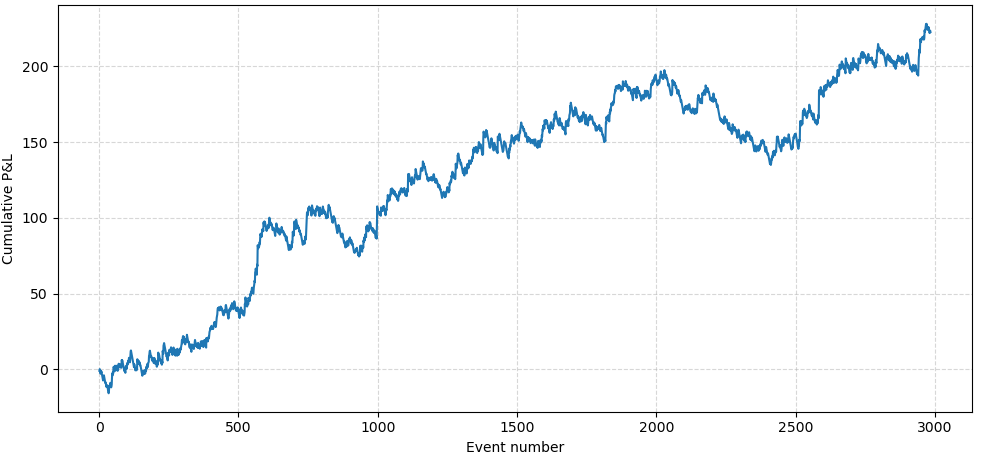
Bets: 2984
Total P&L: £222.57 (based on £1 stakes)
Mean per bet: 0.0746
Average odds: 3.74
Win rate: 38%
Loss rate: 62%
Image

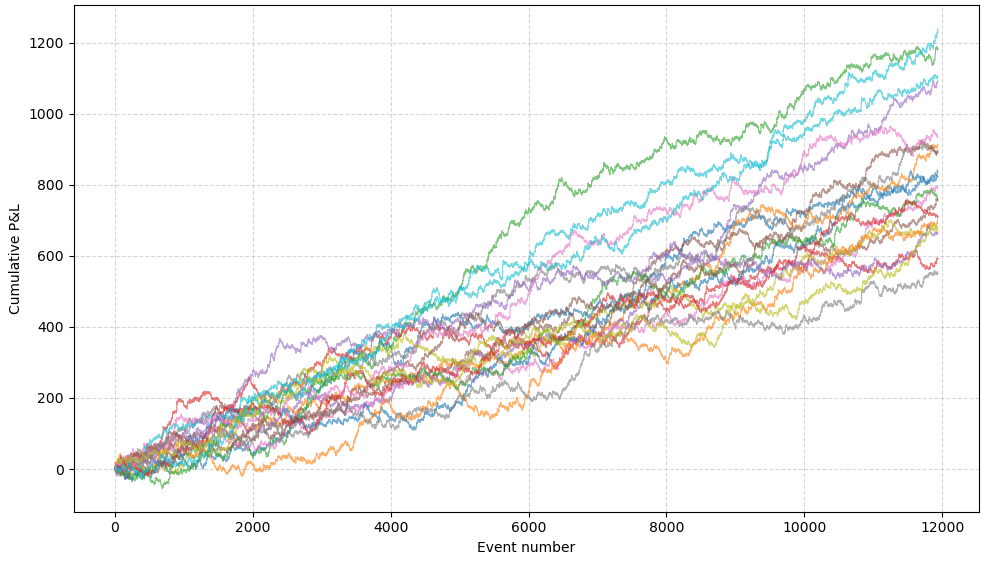
Montecarlo output:

12 month (£1 stakes)
Image


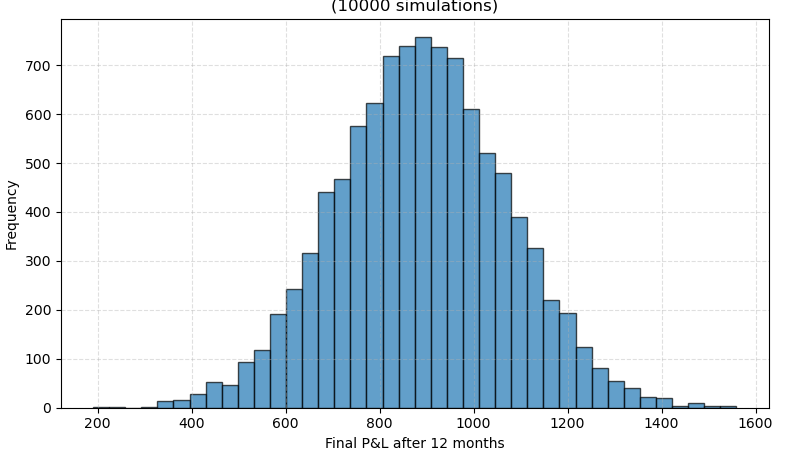
P&L distribution, 10000 12-month simulations:
Image


This is very much a high-volume, low-yield approach, chipping away with small but consistent gains. The strike rate isn’t anything spectacular on the surface, but the pricing efficiency seems to be doing the heavy lifting — the model appears to pick dogs that are regularly mispriced at the BSP. Over the 90-day test window, the strategy produced a £222 profit from flat £1 stakes, which isn’t life-changing, but it’s steady and importantly, easily scalable, since it's betting on BSP.


LAY STRATEGY:

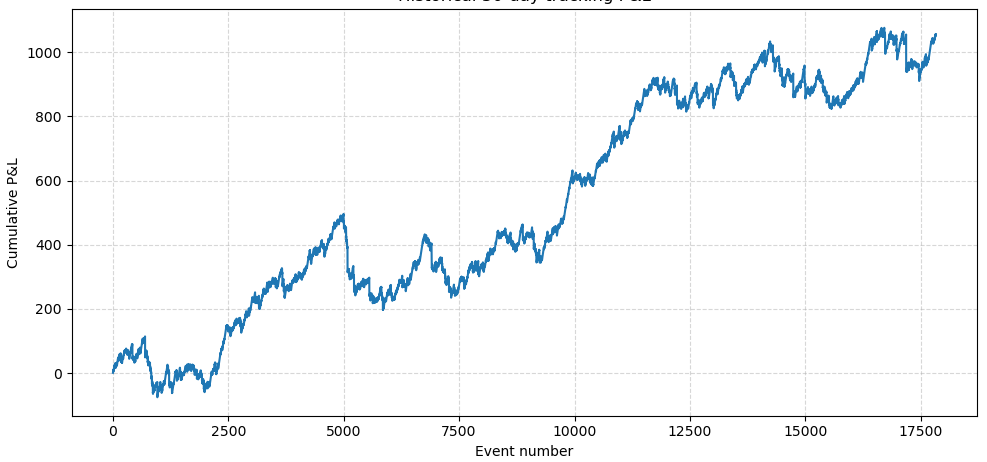
Bets: 17827
Total P&L: £1,056.53 (based on £1 stakes, not liability)
Mean per bet: 0.0593
Average odds: 17.8
Win rate: 88.65%
Loss rate: 11.35%
Image

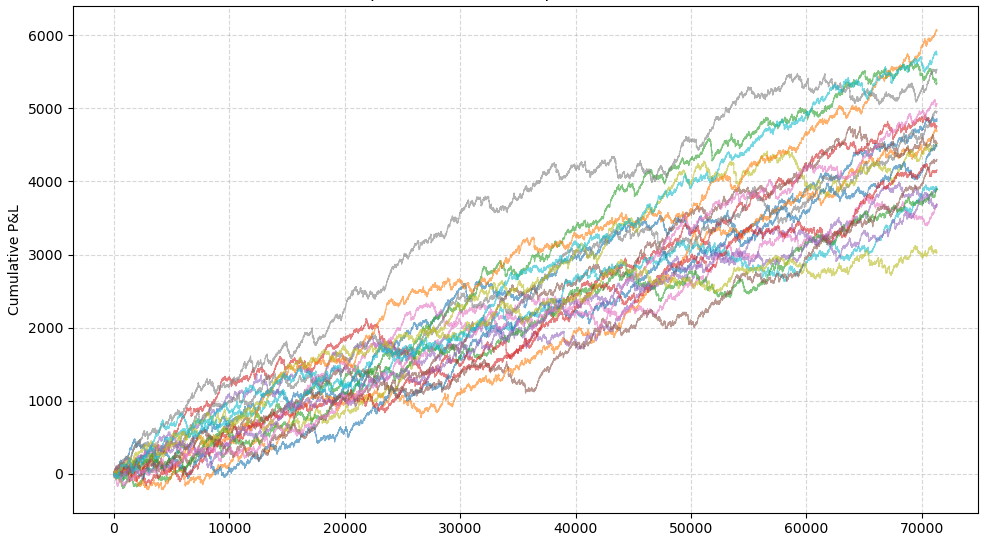
Montecarlo output:

12 month (£1 stakes)
Image

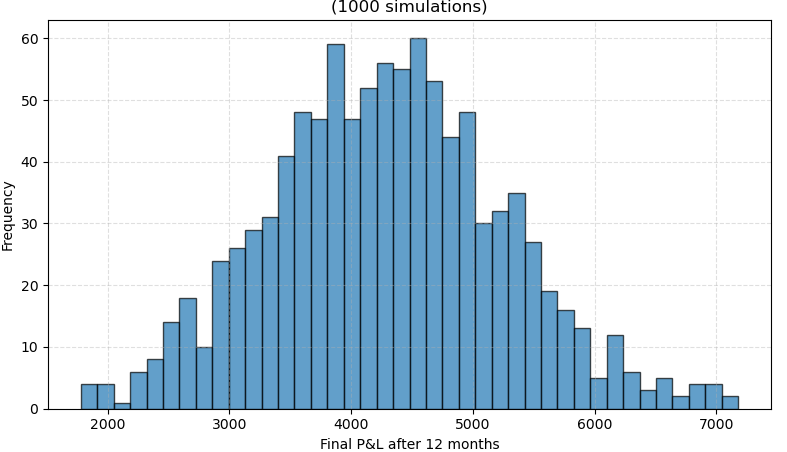
P&L distribution, 1000 12-month simulations:
Image

This strategy operates at the extreme end of the high-volume, low-yield spectrum. On paper, it absolutely dwarfs the Back Strategy in raw profit, returning just over £1,000 from flat £1 stakes across nearly 18,000 bets in 90 days. The hit rate is great — close to 89%. And both the equity curve and Montecarlo projections suggest a very robust upward trajectory over a 12-month period.

However, the apparent profitability needs to be viewed in context. The average lay odds are 17.8, which is frankly uncomfortable territory. Yes, the strike rate keeps the model afloat, but the occasional loser is catastrophic in relative size. When calculating ROI using liability (not the stake), the percentage return collapses to something only marginally above breakeven. That means the strategy isn’t generating large edges per bet — it's simply grinding out thousands of tiny edges and relying on volume to make them visible.

This introduces a practical problem: bankroll requirements. To survive the inevitable losing runs when laying at these odds, you need a very deep wallet and the psychological tolerance to watch large liabilities materialise without flinching.


Final Thoughts / Discussion

One thing I’ve always believed — long before I even wrote a line of code — is that the greyhound markets are incredibly efficient. BSP feels like a brutally accurate reflection of a dog’s true winning chances. And maybe it still is. But these results have left me wondering whether there are pockets of inefficiency that can be systematically exploited… or whether I’ve just been lucky enough to stumble into one during a favourable period.

Both strategies suggest (if that’s the right word) that some kind of edge exists. I’m not claiming I’ve cracked the code or found a magic formula — far from it — but the numbers do raise the question: is this sustainable, or is it simply variance masquerading as skill? The sample sizes are large enough that it feels meaningful, yet part of me keeps thinking I’m missing something obvious that more experienced people take for granted.

So I guess that’s what I’m hoping to understand here. Is this the kind of thing that burns bright for a few months before collapsing? Or is it possible that a casual programmer with a bit of domain knowledge really can uncover inefficiencies that the market hasn’t fully priced in? Can I reasonably expect this to keep working for another three months? A year? Three years? Or am I already bumping into the ceiling and shouldn’t be too proud of myself?

Don’t worry — I’m not quitting my job, mortgaging the house, and buying a yacht called “BSP Beater”. I’m just genuinely curious whether what I’m seeing is:
1. a legitimate, scalable edge,
2. a temporary quirk that will get arbitraged away, or
3. nothing special at all and I’ve just been playing in a statistical sweet spot.

I’d really appreciate honest thoughts from anyone who’s been around this space longer than I have.
Does this look promising, naïve, dangerous, or boringly normal?

User avatar
jamesedwards
Posts: 5007
Joined: Wed Nov 21, 2018 6:16 pm

Looks great to me.

Just one thing re scalability. The thing I've learnt above anything else in Greyhound automation is that increases in stake can very quickly devastate ROI%. So my only advice is that if the time comes when you decide to scale up, then increase stakes very slowly and carefully.
User avatar
jamesedwards
Posts: 5007
Joined: Wed Nov 21, 2018 6:16 pm

On further reflection though, perhaps I am missing something but these numbers don't make sense to me?

It is late and I'm very tired, but at those av odds and win rate the Back Strategy would be running at much greater profit. And on the Lay Strategy you'd need a much higher win rate to be laying an average of 17.8.


BACK STRATEGY:

Bets: 2984
Total P&L: £222.57 (based on £1 stakes)
Mean per bet: 0.0746
Average odds: 3.74
Win rate: 38%
Loss rate: 62%


LAY STRATEGY:

Bets: 17827
Total P&L: £1,056.53 (based on £1 stakes, not liability)
Mean per bet: 0.0593
Average odds: 17.8
Win rate: 88.65%
Loss rate: 11.35%
tc2580
Posts: 7
Joined: Sun Mar 14, 2021 10:13 pm

jamesedwards wrote:
Wed Dec 03, 2025 11:30 pm
On further reflection though, perhaps I am missing something but these numbers don't make sense to me?

It is late and I'm very tired, but at those av odds and win rate the Back Strategy would be running at much greater profit. And on the Lay Strategy you'd need a much higher win rate to be laying an average of 17.8.


BACK STRATEGY:

Bets: 2984
Total P&L: £222.57 (based on £1 stakes)
Mean per bet: 0.0746
Average odds: 3.74
Win rate: 38%
Loss rate: 62%


LAY STRATEGY:

Bets: 17827
Total P&L: £1,056.53 (based on £1 stakes, not liability)
Mean per bet: 0.0593
Average odds: 17.8
Win rate: 88.65%
Loss rate: 11.35%
Thanks for the comment — I think I can see where the confusion comes from.

The average odds I'm quoting are for the bets I actually placed, not the odds of the dogs that went on to win.

Here’s what’s going on:

Back Strategy

Average odds of my selections: 3.74

Average odds of the dogs that actually won: 2.86

So even though I’m backing at an average of 3.74, the ones that hit are typically shorter. If my winners were landing at 3.74 on average, then yes — the profit would be miles higher. That's not what’s happening.

Lay Strategy

Average odds of the dogs I lay: 17.8

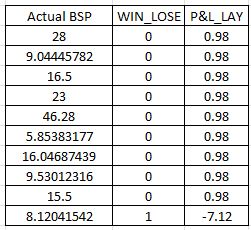
Average odds of the dogs that beat me (actually wins): 8.13

This is the important bit. I’m not losing at 17.8 — my losers are coming in at around 8.13. That’s a huge difference and it’s why the strike rate makes sense, rather than needing something absurd like 95% to stay afloat.
tc2580
Posts: 7
Joined: Sun Mar 14, 2021 10:13 pm

jamesedwards wrote:
Wed Dec 03, 2025 11:22 pm
Looks great to me.

Just one thing re scalability. The thing I've learnt above anything else in Greyhound automation is that increases in stake can very quickly devastate ROI%. So my only advice is that if the time comes when you decide to scale up, then increase stakes very slowly and carefully.
Point taken — I’ve seen plenty of those horror stories on here as well, where everything looks great at £1 stakes and then falls off a cliff the moment someone goes double digits. Totally agree that scaling needs to be done slowly and with a lot of respect for variance.

That said, I think there’s an important distinction with what I’m doing: I’m not trading pre-off or influencing the market — all my bets are going in at BSP. So I’m not fighting for queue position or providing liquidity at worse prices. In theory, that should make the strategy a bit more resistant to the usual scalability issues, since I'm not competing against myself as stakes rise.
User avatar
jamesedwards
Posts: 5007
Joined: Wed Nov 21, 2018 6:16 pm

tc2580 wrote:
Thu Dec 04, 2025 11:26 am
jamesedwards wrote:
Wed Dec 03, 2025 11:22 pm
Looks great to me.

Just one thing re scalability. The thing I've learnt above anything else in Greyhound automation is that increases in stake can very quickly devastate ROI%. So my only advice is that if the time comes when you decide to scale up, then increase stakes very slowly and carefully.
Point taken — I’ve seen plenty of those horror stories on here as well, where everything looks great at £1 stakes and then falls off a cliff the moment someone goes double digits. Totally agree that scaling needs to be done slowly and with a lot of respect for variance.

That said, I think there’s an important distinction with what I’m doing: I’m not trading pre-off or influencing the market — all my bets are going in at BSP. So I’m not fighting for queue position or providing liquidity at worse prices. In theory, that should make the strategy a bit more resistant to the usual scalability issues, since I'm not competing against myself as stakes rise.
Your BSP bets become part of the BSP calculation. As your bet increases the BSP will move against you ceteris paribus.

I often wheel out this old greyhound automation P&L graph. I can't remember exactly what it was doing, but I'm pretty sure it was using BSP.
Impact of stake.PNG
You do not have the required permissions to view the files attached to this post.
User avatar
napshnap
Posts: 1235
Joined: Thu Jan 12, 2017 6:21 am

t’s steady and importantly, easily scalable, since it's betting on BSP.
A dogs bsp is fragile. If the strategy is about placing hundreds around ~5,0-6.0 or tens on big odds, expect SPs to be (at average) =>1 point weaker (being influenced by your bets) than that juicy prices you see. Dogs markets are thin, that's the problem.
tc2580
Posts: 7
Joined: Sun Mar 14, 2021 10:13 pm

I genuinely appreciate the reality check. It doesn’t invalidate what I’ve built, but it definitely reframes how cautiously I need to approach the next steps. It also makes sense that in markets where there’s often under £10k matched per race, every extra pound I add is going to have some influence on the BSP — probably more than I initially realised.
LinusP
Posts: 1929
Joined: Mon Jul 02, 2012 10:45 pm

Run the same analysis but use liability instead rather than fixed stakes, for example a £100 bankroll.

This has the advantage of reducing your impact (lower prices = more liquidity) and stops your pnl being dwarfed by high priced runners.
Post Reply

Return to “Sports betting strategies”